Seeding & Sod
Grass Seed vs Sod: Cost, Time, and Trade-offs
Sod vs seed: which is right for your yard? Compare costs, establishment timelines, and real trade-offs to choose the smarter option for your lawn.
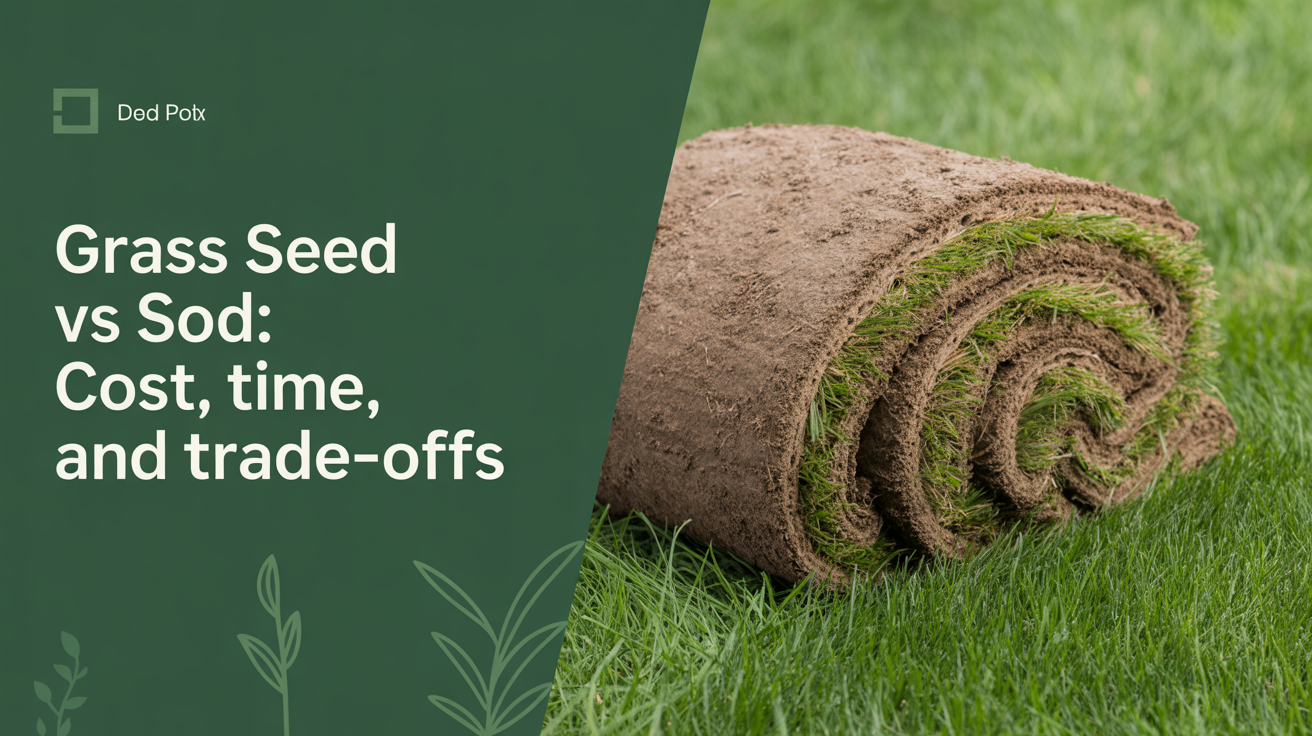
The fastest answer to the sod vs seed question: sod gives you an instant lawn but costs three to ten times more; seed costs far less but asks you to wait and protect bare soil for weeks. Neither is universally better. Which one fits your situation depends on budget, timing, grass type, and how much babysitting you are willing to do.
Read on for the full breakdown.
What Seed and Sod Actually Are
Grass seed is exactly what it sounds like: dry seeds sown onto prepared soil, germinated in place, and grown out from scratch over several weeks. Sod is grass that has already been grown by a farm, harvested in strips or rolls with a thin layer of roots and soil still attached, and transplanted directly to your yard.
Both methods can produce a healthy, permanent lawn. The difference is mainly where the establishment work happens. With seed, it happens in your yard over the first few growing season weeks. With sod, most of the early growth work happened at the farm, and you are paying for that convenience.
Understanding your grass type matters before you choose either route. Cool-season grasses like tall fescue and Kentucky bluegrass establish best when sown or laid in late summer to early fall, when soil is warm and air is cooler. Warm-season grasses like bermuda, zoysia, and St. Augustine perform best when started in late spring to early summer. Sod installed in the wrong season still roots, but it stresses the grass and costs more in water. See cool-season vs warm-season grass: which is right for your yard if you are still sorting out which type your climate needs.
Cost of Sod vs Seed: What to Budget
The cost gap between sod and seed is real and wide.
Grass seed for a typical home lawn runs roughly $0.05 to $0.20 per square foot in seed cost alone, depending on species and blend quality. A 5,000-square-foot lawn might need $50 to $150 in seed. Add in starter fertilizer, any soil amendments, and equipment rental (a slit-seeder or lawn roller if you do not own one) and a full DIY seed project for that same area could land between $150 and $400.
Sod is typically priced by the square foot or by the pallet, and prices vary by region and grass type. Budget roughly $0.30 to $0.80 per square foot for the sod itself before any installation labor. A 5,000-square-foot lawn in sod material alone could run $1,500 to $4,000. Professional installation, which includes grading and laying, adds more. Total installed costs can easily reach $1.50 to $3.00 per square foot depending on where you live.
For a ballpark comparison on that same 5,000 sq ft:
- DIY seed: $150 to $500
- DIY sod materials only: $1,500 to $4,000
- Professionally installed sod: $5,000 to $15,000+
These are rough ranges, not guarantees. Local labor rates, soil prep requirements, grass species, and current material costs all move the number. Get a local quote before committing.
One cost that often gets overlooked with seed: if germination fails (poor watering, birds, heavy rain washing seed) you may need to reseed and start over. That does not happen with sod, which is already established before it arrives.
How Long Sod Takes to Root (and How Long Seed Takes to Germinate)
This is where sod earns its price for many homeowners.
Sod establishment works in two phases. The first phase is knitting, where the new roots grow through the sod mat and into your native soil beneath. This takes roughly two to three weeks under good conditions. You can usually walk on sod lightly after one week. Full root integration, where the sod is solidly anchored and no longer peels up, typically takes four to six weeks. You should not mow sod until it resists a gentle tug and the blade height makes it necessary.
Keep newly laid sod consistently moist for the first two weeks. Once or twice a day in dry or hot weather. After the roots begin anchoring, you can back off to deep, less frequent watering.
Seed germination depends heavily on grass type:
- Perennial ryegrass: 5 to 10 days
- Tall fescue: 7 to 14 days
- Kentucky bluegrass: 14 to 28 days (sometimes longer)
- Bermudagrass: 10 to 30 days
- Zoysiagrass: 14 to 21 days
But germination is just sprouting. New grass seedlings are fragile and need another 4 to 8 weeks of growth before the lawn can handle foot traffic or the first mow. From bare soil to a usable lawn, seed typically takes 6 to 12 weeks. With slower species like Kentucky bluegrass, you might not have a solid stand for a full growing season.
The practical difference: sod gives you a walkable surface in roughly a month. Seed asks you to stay off the lawn for two to three months and protects fragile seedlings from erosion, birds, and drought the whole time.
Trade-offs Beyond Cost and Time
Soil contact matters more with sod. Sod needs good contact with your native soil to knit properly. If air pockets form under the rolls or the ground underneath is not reasonably level, sections of sod can dry out and die. Poor installation is the main reason sod fails.
Seed gives you more species choices. Sod farms grow what sells regionally and in volume. If you want a specific tall fescue blend suited to your local climate, or a low-input buffalo grass variety, seed gives you access to a wider range of cultivars. Sod your region tends to carry is limited to the high-demand varieties. This matters more in transitional zones where neither pure cool-season nor warm-season grass excels.
Sod handles slopes better short-term. On a steep grade, seed is at constant risk of washing away before it establishes. Sod, once laid and pegged if needed, holds the slope while rooting. For significant grades, sod is nearly always the better choice purely from an erosion standpoint.
Seed integrates into existing soil. Seedlings grow roots directly into your native soil from day one, which some turf researchers argue produces a stronger root system over time than sod, which has to bridge two distinct soil layers. This is a long-term consideration and matters more on certain soil types than others.
Weather windows are tighter with sod. If you install sod during a heat wave and cannot water multiple times a day, the edges dry out and die fast. Seed is more forgiving in extreme weather because you can delay sowing until conditions improve.
When to Choose Seed vs Sod
Choose seed when:
- Budget is the primary constraint
- You have time to wait (at least two months before the lawn needs to be usable)
- You want a specific grass cultivar not available in sod
- You are overseeding thin patches rather than starting from scratch
- The area is flat and you can protect seedlings from erosion
Choose sod when:
- You need a usable lawn quickly (new construction, staging a home, a yard used by dogs or kids)
- You are covering a slope where seed would wash
- You want near-guaranteed coverage with lower risk of bare patches
- The area is too small to make seeding equipment rental cost-effective
- You are laying a warm-season grass in a region where seed is hard to establish from scratch (St. Augustine, for example, is almost always sodded because it does not produce viable seed in most settings)
For patchy existing lawns, overseeding is almost always the better route before considering sod. You can read more about that approach in how to overseed a thin lawn for a thicker stand.
If you have decided seed is the right path and are starting from bare ground, starting a new lawn from seed: start to finish covers soil prep, timing, and the first mow in detail.
Frequently Asked Questions
Is sod or seed better for a new lawn?
Neither is better in every situation. Sod is faster and more reliable but significantly more expensive. Seed is cheaper and offers more variety but takes longer to establish and requires more careful watering and protection. For most homeowners on a budget who can wait two to three months, seed is the practical choice. For anyone who needs results fast or is covering a slope, sod is worth the cost.
How long does sod take to root completely?
You should expect two to three weeks before sod starts knitting into your native soil, and four to six weeks before it is fully anchored. Do not mow until the sod resists a gentle tug. Full root establishment, where the sod behaves like native-grown grass, typically takes a full growing season.
What is the actual cost difference between sod and seed?
For a 1,000-square-foot area, DIY seed might cost $30 to $100 all in. The same area in sod materials alone could run $300 to $800, and professionally installed could be $1,500 or more. The gap scales with square footage. For large areas, seed saves a substantial amount of money.
Can I mix sod and seed on the same lawn?
Yes, though it takes some planning. If you are filling in a damaged section with sod while seeding adjacent bare areas, make sure the grass species match closely so the lawn looks uniform once established. The two methods do not interfere with each other when used in different zones of the yard.
Does sod require less watering than seed?
Not initially. Newly laid sod actually needs heavy watering for the first two weeks to prevent the mat from drying out before it roots. Once established (after four to six weeks), it behaves like any mature lawn and needs only normal irrigation. Seed also requires consistent moisture during germination but is more tolerant of short dry spells because the seedlings are already in contact with native soil.