Weeds & Pests
Common Lawn Diseases and How to Treat Them
Learn how to identify common lawn fungal diseases like brown patch, dollar spot, and red thread, and find out which fungicide for grass actually works.

If your lawn has irregular brown patches, slimy rings at dawn, or grass blades that look scorched but weren't touched by heat, there is a reasonable chance you are dealing with a fungal disease. The good news is that most common lawn diseases are identifiable, treatable, and often preventable with a few cultural adjustments. This guide walks through the diseases you are most likely to encounter and explains what to do about each one.
At a Glance
- Circular or ring-shaped damage, cottony residue on blades at dawn, and symptoms after warm, humid nights point to fungus rather than drought or grubs.
- Brown patch (mid to late summer, cool-season grass) and dollar spot (spring/fall, most types) are the two most commonly reported lawn fungal diseases.
- Michigan State University Extension notes brown patch becomes active once soil temperatures pass 60 degrees Fahrenheit and nighttime air stays in the 70s with high humidity.
- Morning watering, correct mowing height, and avoiding excess nitrogen in high-risk periods prevent more disease than any fungicide.
- Fungicides are protectants, not cures. They stop new infection but will not reverse damage already done.
- If the same spot gets sick every year, look for a drainage or air-circulation cause before reaching for chemicals again.
How to Tell If Your Problem Is Fungal
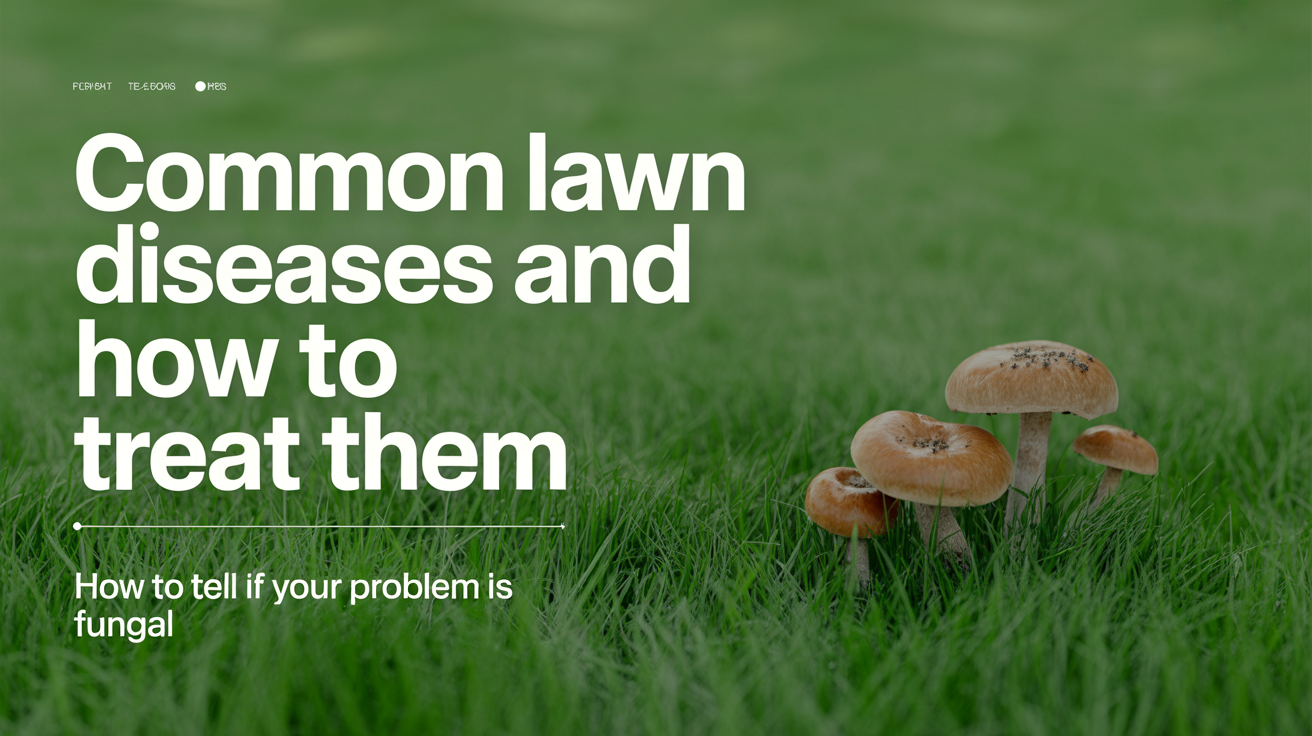
Lawn diseases can look a lot like drought stress, fertilizer burn, grub damage, or dog spots. Before reaching for a fungicide, spend a few minutes ruling out the obvious causes.
Signs that point toward fungus rather than other problems:
- The pattern is circular or roughly ring-shaped, not random or aligned with a dog's path
- Individual grass blades show lesions, discoloration at the tips, or a powdery coating
- You notice a white, gray, or orange residue on blades in the morning
- The damage appeared after a stretch of warm nights with high humidity or after heavy rain followed by little wind
- Cool-season grass shows symptoms in mid to late summer; warm-season grass shows them during humid spring stretches
If none of those apply, it is worth checking for crabgrass or other weeds that can mimic bare patches when they die back.
Common Lawn Diseases and What They Look Like
Brown Patch (Rhizoctonia solani)
Brown patch disease is one of the most widespread turf diseases in the country. It hits cool-season grasses (tall fescue, Kentucky bluegrass, perennial ryegrass) hardest during hot, humid nights. MSU Extension pins down the specific trigger: the fungus survives in thatch and becomes active once soil temperatures climb above 60 degrees Fahrenheit, then really takes off when air temperatures push past 80 degrees Fahrenheit during the day with nighttime lows still in the 70s and high humidity. That combination typically runs from June through September in most of the country.
What to look for: circular patches ranging from a few inches to several feet across, often with a darker, water-soaked ring around the outside edge in the early morning. The center of older patches may recover, leaving a donut shape. Individual blades rot at the sheath and pull out easily.
Brown patch thrives when turf goes into the night wet. Watering in the evening is a reliable way to invite it. MSU's guidance also flags nitrogen as a factor: limiting applications to no more than half a pound of nitrogen per 1,000 square feet during the height of summer reduces the lush, disease-prone growth that brown patch favors.
Dollar Spot (Clarireedia jacksonii)
Dollar spot produces small, tan, roughly circular spots about the size of a silver dollar, typically 2 to 6 inches in diameter according to Clemson HGIC, though they can merge into larger irregular patches on close-cut turf. Look for cottony white mycelium on blades in early morning and straw-colored lesions with reddish-brown borders across individual blades.
It is most active in spring and fall when days are warm and nights are cool. Lawns low in nitrogen are more susceptible, which makes dollar spot partly a soil-fertility problem alongside being a fungal one; correcting a nitrogen deficiency is often enough to slow it without any fungicide.
Red Thread (Laetisaria fuciformis)
Red thread is easy to identify because the blades develop pinkish-red threads extending past the leaf tips, giving patches a faintly pink or coral tint. It is common in fine fescues and perennial ryegrass during cool, moist weather in spring and fall.
Like dollar spot, red thread often signals nitrogen deficiency. A modest fertilizer application at the right time frequently suppresses it without any fungicide at all, usually within two to three weeks of the grass resuming vigorous growth.
Fairy Ring
Fairy ring shows up as a circle or arc of darker green grass, dead grass, or mushrooms in the lawn. The underlying cause is a soil-dwelling fungus breaking down organic matter below ground. The darker ring appears because the fungus releases nitrogen as it decomposes. In severe cases, a hydrophobic mat of fungal mycelium forms just below the surface and prevents water from reaching roots.
Fairy ring is difficult to eradicate completely because the fungus lives deep in the soil, sometimes more than a foot down in old, buried organic debris like tree stumps or root systems. Aerating, wetting agents, and removing dead organic matter help manage it, though a full cure can take years in stubborn cases.
Powdery Mildew
This one is hard to miss: a white to grayish powder coats the surface of grass blades, usually in shaded, poorly circulated areas. Powdery mildew is common on Kentucky bluegrass growing under trees or along north-facing fence lines. Improving air flow and light is more effective long-term than fungicide applications; thinning nearby shrubs or raising a tree canopy by a few feet can resolve a chronic case that fungicide alone never fully clears.
Rust and Gray Leaf Spot
Two less commonly discussed but still frequent diseases round out the list. Rust appears as tiny orange to reddish-brown flecks that enlarge into raised pustules on the blade surface, easy to confirm by wiping a shoe across wet grass and checking for an orange residue. It is worse under shade stress and low nitrogen, similar to dollar spot. Gray leaf spot produces tan to gray spots with purple-brown margins and is a serious concern specifically for St. Augustinegrass lawns in warm, humid climates, where it can spread fast enough to thin an entire lawn in a matter of weeks if left untreated.
Lawn Fungus Treatment: What Actually Works
Start with cultural fixes before spraying. Many fungal diseases are heavily influenced by how you water, mow, and fertilize.
- Water in the morning so blades dry out during the day. Evening watering that leaves turf wet overnight is one of the most consistent disease risk factors.
- Mow at the right height for your grass type. Scalping stresses turf and leaves wounds that invite infection.
- Avoid excess nitrogen during high-disease-risk periods, particularly in late summer for cool-season grasses. That said, correcting a deficiency (as with dollar spot and red thread) can actually reduce disease pressure.
- Dethatch if thatch exceeds half an inch. Thatch holds moisture near the crown and creates a favorable environment for pathogens.
When to use a fungicide for grass: If you have correctly identified a fungal disease and cultural adjustments have not slowed the spread within a week or two, a fungicide is a reasonable next step. A few practical notes:
- Fungicides are mostly protectants, not curatives. They slow or stop new infections but do not reverse damage already done. Apply early.
- Active ingredients to look for include azoxystrobin, propiconazole, and myclobutanil, which are available in residential formulations. MSU Extension's brown patch guidance separates these further: contact fungicides like chlorothalonil need reapplication every 7 to 10 days, while systemic options such as flutolanil or trifloxystrobin protect for 14 to 21 days per application. Read the label to confirm the disease you are targeting is listed.
- Rotate active ingredients if you apply more than once in a season. Using the same chemistry repeatedly selects for resistant strains.
- Follow label rates exactly. More is not better and creates runoff and resistance risk.
- Systemic fungicides move into the plant tissue and protect from within; contact fungicides stay on the surface and wash off with rain. Many products combine both modes.
The Lawn Almanac is not affiliated with any chemical brand. Always read the full product label before applying any fungicide, and follow re-entry intervals and disposal instructions.
A Quick Reference Table
| Disease | Grass Types Affected | Peak Season | Key Visual Sign | First Response |
|---|---|---|---|---|
| Brown patch | Cool-season (tall fescue, ryegrass) | Mid to late summer | Dark ring around patch at dawn | Morning watering, reduce nitrogen |
| Dollar spot | Most types | Spring and fall | Straw-colored lesions, white mycelium | Correct nitrogen deficiency |
| Red thread | Fine fescue, ryegrass | Cool, moist spring/fall | Pink-red threads on blade tips | Light nitrogen application |
| Fairy ring | All types | Spring and fall | Dark green arc or mushroom ring | Aerate, wetting agent |
| Powdery mildew | Kentucky bluegrass | Cool, shaded areas | White powder on blades | Improve air flow and light |
| Rust | Most types, worse under stress | Late summer, low nitrogen | Orange dust on shoes after mowing | Correct nitrogen, reduce shade stress |
| Gray leaf spot | St. Augustinegrass | Warm, humid weather | Tan-gray spots, purple-brown margin | Resistant cultivar, azoxystrobin fungicide |
Fungicide Timing: Contact vs. Systemic
| Type | Reapplication interval | Rain sensitivity | Best used for |
|---|---|---|---|
| Contact (chlorothalonil, mancozeb) | Every 7-10 days | Washes off within 2-4 hours of rain | Fast knockdown, rotating with systemics |
| Systemic (azoxystrobin, propiconazole, flutolanil) | Every 14-21 days | Rain-resistant once absorbed (a few hours to dry) | Longer-lasting protection, fewer applications |
Prevention Through Better Lawn Habits
Lawn fungus identification is useful, but preventing disease in the first place is easier than treating it. A few habits go a long way.
Aerate annually, especially on compacted clay soils. Compaction reduces drainage and keeps the root zone wet longer after rain. Core aeration also breaks up thatch.
Overseed thin or bare areas in the appropriate season (fall for cool-season grasses, late spring for warm-season). Dense, healthy turf crowds out pathogens and resists infection better than stressed, sparse grass.
Pay attention to irrigation uniformity. Wet spots from poorly aimed sprinklers or low spots that collect water will show disease before the rest of the lawn. Adjusting spray heads or improving drainage there can break a recurring cycle.
If you are also battling weeds alongside disease, it helps to understand what control options are appropriate for the timing. The difference between pre-emergent and post-emergent herbicides matters a lot when disease recovery is already stressing the turf. Applying the wrong type at the wrong time can compound the problem.
Some weeds like clover can also give the appearance of patchy disease recovery. If you see clumping white-flowered patches after treating for fungus, that is a different issue to address. See the guide on getting rid of clover in the lawn if that applies to your situation.
Frequently Asked Questions
Can I treat lawn fungus without chemicals?
In many cases, yes. Dollar spot and red thread often resolve with a corrective nitrogen application and improved watering timing. Brown patch can sometimes be managed by switching to morning watering alone, combined with keeping nitrogen under half a pound per 1,000 square feet during the hottest weeks of summer. If the disease is advanced or keeps returning season after season despite cultural changes, a fungicide becomes more practical.
How long does it take for grass to recover after a fungal disease?
This depends on the disease, the grass type, and how quickly you addressed it. Brown patch damage can look bad for several weeks but cool-season grasses often recover on their own as temperatures drop in fall, since the crowns typically survive even when the blades look severely burned. If the crown and roots survived, the plant will regrow. If recovery is slow, overseeding into the affected area in fall helps fill gaps faster.
Will rain wash off the fungicide I just applied?
It depends on the product. Contact fungicides are more sensitive to rainfall shortly after application; most labels specify a rain-free window (often two to four hours). Systemic fungicides are absorbed into the plant tissue more quickly and hold up better once they have had time to dry, though even systemics generally need at least a couple of dry hours to fully take up into the leaf tissue.
Is it safe to let kids and pets on the lawn after applying fungicide?
The product label will specify a re-entry interval, which is the time you should keep people and animals off treated turf after application. This varies by active ingredient and formulation. Follow the label rather than guessing. Once dry and the interval has passed, most residential fungicides are considered low risk under normal conditions, but the label is the authoritative source, not general advice.
Why does the same spot get brown patch every summer?
Some conditions make certain areas of a lawn persistently prone to disease. Low spots that stay wet, areas with poor air circulation (near fences or dense shrubs), or sections of turf that stay in shade and never fully dry out will cycle through disease year after year. Correcting the drainage or air flow issue, or overseeding with a more disease-resistant variety, tends to break the pattern more reliably than annual fungicide applications.
Do fungal diseases actually kill grass, or just damage it temporarily?
Most common lawn fungal diseases, including brown patch, dollar spot, and red thread, damage the leaf blades without killing the crown or root system in a healthy, otherwise well-maintained lawn. That is why cool-season grass so often "grows out of" brown patch once fall temperatures arrive. The exceptions are severe, repeated infections on already-stressed turf (drought, heavy shade, poor drainage) or fairy ring's underground mycelial mat, which can kill grass outright by blocking water from reaching the roots. A lawn that is otherwise healthy going into a disease outbreak has a much better prognosis than one that was already struggling.