Tools & Equipment
How to Use a Broadcast Spreader Correctly
Use a broadcast spreader the right way: set the rate from the bag, apply header strips, overlap at half rate, and calibrate to prevent striping.
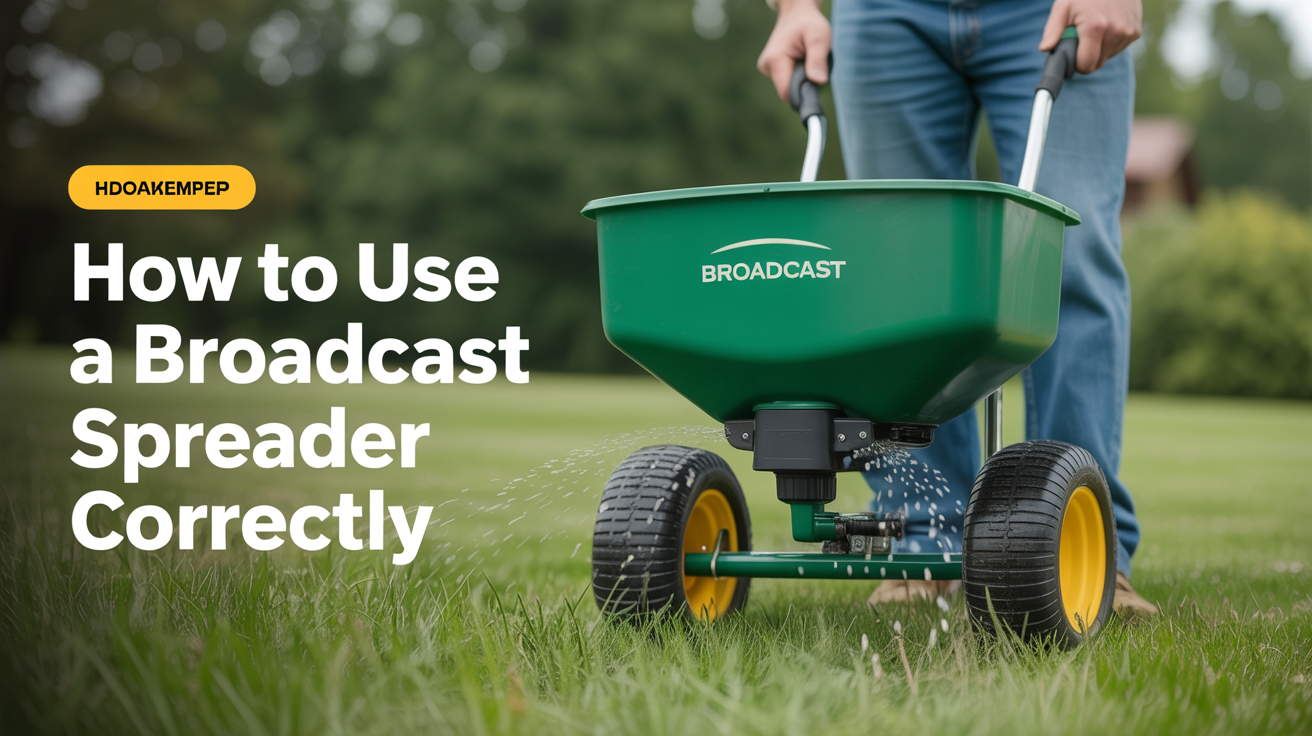
A broadcast spreader throws granules in a wide arc as you walk, making it the fastest way to cover a lawn evenly. The short answer on how to use one: look up your product's recommended setting on the bag, dial it in, make a perimeter pass around the edges first, then walk back-and-forth rows across the interior with a slight overlap. Calibrate beforehand if you haven't used the spreader in a while, and clean it out after every use. Everything below explains why those steps matter and how to do them right.
Broadcast vs. Drop Spreader: When Each Makes Sense
These two spreader types solve different problems.
A broadcast (or rotary) spreader spins a disc underneath the hopper, flinging granules out to either side. Coverage widths typically run 8 to 12 feet per pass, so you can cover a 5,000-square-foot lawn in roughly 10 to 15 passes. That efficiency is the main draw.
A drop spreader releases product straight down through holes in the bottom of the hopper. The spread width equals the width of the spreader itself, usually around 24 inches. You lose speed, but you gain precision: drop spreaders won't accidentally scatter fertilizer into flower beds, onto pavement, or over a neighbor's property line.
When to use a broadcast spreader:
- Open lawns with few obstacles
- Large areas where coverage speed matters
- Any granular product where a foot or two of edge imprecision is acceptable
When a drop spreader is the better call:
- Narrow strips, yards surrounded by hardscape, or lawns with lots of planting beds
- Situations where you're overseeding right up to a bed edge and want no bleed
- Herbicides with tight label restrictions on drift
Most homeowners reach for the broadcast spreader most of the time. If your lawn has a lot of curves and tight corners, a drop spreader alongside it for edging zones is a reasonable combination.
Finding the Right Setting and What the Dial Actually Means
The dial on a broadcast spreader controls the size of the opening at the bottom of the hopper. A higher number means a larger opening and more product flow per square foot. It does not correspond to a universal rate across brands.
Always start with the product bag, not a guess. Fertilizer, herbicide, and grass seed manufacturers test their formulations at specific spreader settings and print a chart on the back of the bag. That chart maps common spreader brands (Scotts, Earthway, Agri-Fab, Andersons) to a recommended dial number. Find your spreader brand in the chart, set the dial to that number, and you're calibrated for that product at the label rate.
What if your spreader brand isn't listed? A few options:
- Look for a "universal" or "all other" row on the bag's chart. Start at the lower end of that range.
- Calibrate manually (see the section below) to confirm your actual output rate before covering the whole lawn.
One common mistake: people assume a higher setting will feed the lawn faster in a good way. But applying fertilizer above the label rate risks burning the grass, and doubling the herbicide rate can damage turf or create runoff. The label rate is the tested rate. Stay on it.
Proper Technique: Header Strips, Overlaps, and Turning
Good broadcast spreader technique comes down to four habits.
Make header strips first. Before you start your main rows, walk a single pass along the perimeter of the lawn on all sides. These header strips give you room to turn around at the end of each row without spreading product into the beds or off the property. Close the hopper every time you turn (there's usually a lever or foot trigger for this), then open it again once you're pointed in the right direction and moving.
Walk at a consistent pace. Spreading works on the assumption that you cover ground at roughly the same speed the product was tested at, typically around 3 mph, a moderate walking pace. Slowing down concentrates product; speeding up thins it. If you need to stop, close the hopper before you do.
Overlap rows slightly. The throw pattern from a broadcast spreader is heaviest in the center and tapers off toward the edges. If you leave a full 10-foot gap between your passes, you'll end up with faint stripes of lighter coverage. A practical rule: aim to walk so the edge of your throw pattern overlaps by about 1 to 2 feet with the previous row. On a 10-foot spreader, that means your walking lines are about 8 to 9 feet apart.
Use a half-rate criss-cross pattern for critical applications. For fertilizers, especially fast-release ones, many turf professionals split the application rate in half and make two passes at 90 degrees to each other. Set the dial to the half-rate position (you may need to calculate or estimate this), cover the lawn in one direction, then cross the whole area again perpendicular to the first pass. The result is more uniform coverage and far less risk of striping. It takes twice as long, but it's the technique used on golf fairways and athletic fields where even color matters.
After each pass, sweep any granules off driveways, sidewalks, and curbs back onto the lawn. Granules left on pavement wash into storm drains when it rains, which is both wasteful and a water-quality problem.
Calibrating Your Spreader
Calibration confirms that your spreader actually delivers the label rate. It's especially important for older spreaders (where the hopper opening may have worn or shifted) or when you're using a product that doesn't list your spreader brand.
Here's a simple catch-and-weigh method:
- Weigh out a known amount of product. A 2-pound sample works well.
- Attach a catch bag or tarp under the spreader. You can improvise with a large garbage bag duct-taped around the spreader's discharge chute area.
- Mark off a test strip. Calculate the area you need to cover for the label rate. For example, if the label says 5 lbs per 1,000 sq ft and you want to test 200 sq ft, the correct output should be 1 lb.
- Walk your test strip at your normal pace with the dial at the recommended setting.
- Weigh the product you collected. Compare it to the target amount.
- Collected more than target: reduce the dial setting slightly.
- Collected less: increase it.
- Within 10% of target: you're close enough.
Recalibrate any time you switch products, because granule size and density vary significantly between, say, a coated slow-release fertilizer and fine grass seed.
Cleaning and Storing the Spreader
Fertilizer granules are hygroscopic, meaning they pull moisture from the air. Leave them in the hopper overnight and they'll clump, clog, and corrode the metal parts.
After every use:
- Empty any remaining product back into the bag. Don't leave it in the hopper.
- Rinse the hopper and chassis with clean water, using a garden hose.
- Pay attention to the impeller (the spinning disc) and the opening mechanism. Granules pack into those spaces and cause uneven spread later.
- Let the spreader dry completely before storing it, or wipe it down to prevent rust.
- A light spray of WD-40 or similar lubricant on the axle and any metal joints helps prevent corrosion between seasons.
A spreader that's cleaned after each use will last years longer than one that's stored dirty. It also performs more predictably, which is the whole point of using one.
If you're building out your lawn-care toolkit more broadly, understanding how your mower fits into the picture matters too. Choosing between a push, self-propelled, or riding mower depends on your yard's size and terrain, and that decision affects how you coordinate mowing with your fertilizer timing. Similarly, the shift toward electric vs. gas lawn mowers is worth thinking through before your next equipment purchase. And if your mower blade is dull, the stress cuts your turf causes will work against any fertilizer you apply; sharpening and balancing a mower blade is one of the higher-return maintenance tasks you can do.
Frequently Asked Questions
How much overlap should I use with a broadcast spreader?
A 1 to 2-foot overlap with the edge of your previous pass is the standard recommendation. The throw pattern thins out near the edges, so this overlap compensates and keeps coverage even. If you're seeing stripes in your lawn after the product greens up, increase your overlap slightly on the next application.
Can I use any spreader setting for any fertilizer?
No. Granule size, density, and desired application rate vary between products. Always check the product bag for the setting chart, and find your spreader's brand in it. Using a setting calibrated for one product on a different product can result in under-application (grass doesn't green) or over-application (burn spots).
Why does my lawn have green stripes after fertilizing?
Stripes mean uneven coverage, almost always from insufficient overlap between passes. The lighter green strips between the darker ones received less fertilizer. To fix it going forward, walk your rows closer together (more overlap), or use the half-rate criss-cross method where you apply in two perpendicular passes at half the dial setting each time.
Should I water after spreading fertilizer?
For most granular fertilizers, yes. Watering after application activates the product and moves it off the leaf surface and into the soil. Check the product label for specifics, but a 1/4-inch of water after applying is a common guideline. Slow-release fertilizers are more forgiving, but even they benefit from watering within 24 to 48 hours.
How do I clean a clogged spreader?
Close the hopper, turn the spreader upside down, and shake it to dislodge packed granules. Rinse the hopper and impeller area thoroughly with a hose. Check the hole opening mechanism (the slide or gate) to make sure granules aren't packed behind it. If granules have hardened inside, soak the area briefly with water and use a stiff brush to break them up. Running the spreader empty for a moment after loading a new batch can help confirm the opening is clear before you start.