Tools & Equipment
Push, Self-Propelled, or Riding: Choosing the Right Mower
Not sure which mower to buy? Match your yard size and terrain to the right type — push, self-propelled, riding tractor, zero-turn, or robotic.
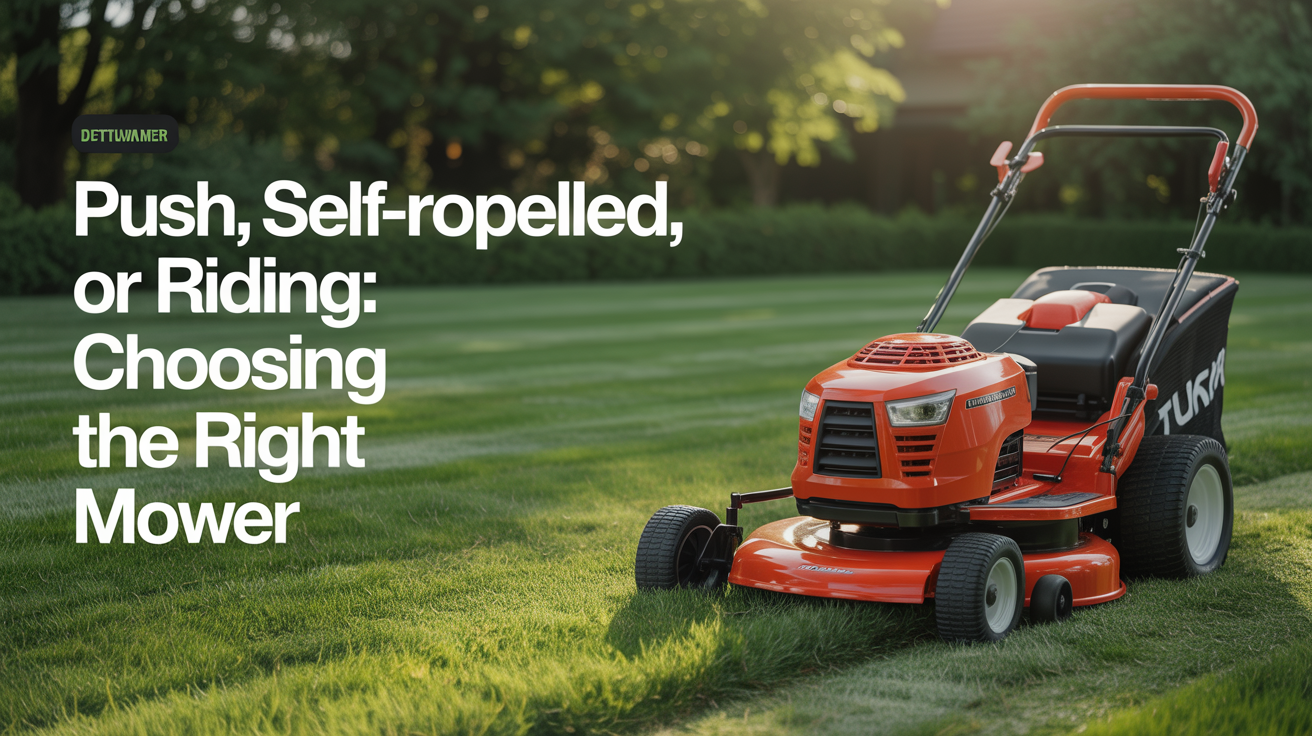
The short answer is this: if your lawn is under a quarter acre and reasonably flat, a basic push mower gets the job done. From a quarter to about half an acre, a self-propelled mower saves real effort. Beyond half an acre, especially past three-quarters, a riding mower or zero-turn starts making economic sense in saved time and physical wear. That's the framework. Everything below explains the nuances behind it.
The Main Mower Types Explained
Understanding what each machine actually does helps before you match one to your yard.
Reel mowers use a cylinder of spinning blades that cut against a fixed bottom blade, like scissors. They produce the cleanest cut and work well on flat, fine-turf lawns, but they struggle with anything over about a half inch of growth and can't handle rough terrain or tall grass. They're quiet, require no fuel, and suit small, well-maintained city lots.
Push rotary mowers are the standard gas or electric mowers most homeowners picture. A single horizontal blade spins fast enough to cut by impact rather than slicing. You push them manually. They handle uneven ground, longer grass, and modest slopes reasonably well. The trade-off is physical effort on larger yards or inclines. For anything over 5,000 square feet, the workout adds up quickly.
Self-propelled mowers use the same rotary blade setup but add a drive system that moves the wheels forward at an adjustable pace. You guide rather than push. Most run on rear-wheel or all-wheel drive, which matters on slopes — rear-wheel drive gives better traction going uphill, while front-wheel drive suits flatter ground with more turning. Self-propelled models run in both gas and battery configurations, and if you're weighing fuel types, the guide on electric vs. gas lawn mowers covers that comparison in depth.
Riding lawn tractors put you in a seat and use a wide deck (typically 42 to 54 inches) to cover ground fast. They steer like a car, with a front-axle turning radius that requires some space to maneuver. They work well on open, gently rolling property. They're slow around tight obstacles.
Zero-turn mowers also put you in a seat but steer with lap bars that control each rear wheel independently. The turning radius is effectively zero, which means they can spin in place and cut close around trees, beds, and obstacles without repeated passes. They're fast and efficient on open ground but can struggle on steep slopes because that pivot-steering design reduces traction control on grades over about 10 to 15 degrees.
Robotic mowers work like robotic vacuums: they roam within a boundary wire, cutting a small amount daily rather than all at once. Setup takes a few hours. Running costs are low, and the lawn stays consistently trimmed without effort. The limitations are real, though. Most handle only modest slopes (up to about 20 degrees), and complex yard layouts with islands or separated zones add complexity. They're genuinely useful for homeowners who want a hands-off approach and have a straightforward lawn shape.
Matching Mower to Yard Size and Terrain
Yard size is the starting point, but slope and layout matter nearly as much.
Under 1/4 acre (roughly 10,000 sq ft): A push rotary mower is adequate for most yards this size. A reel mower works if the turf is fine and kept short. Battery-electric push mowers have become a strong choice at this scale, with enough runtime on a single charge for most sessions.
1/4 to 1/2 acre: This is where a self-propelled mower pays for itself. The extra cost (typically $100 to $200 over a comparable push model) comes back quickly in reduced fatigue, especially if there's any slope. Choose rear-wheel drive if your yard tilts noticeably; front-wheel drive is fine on flat ground.
1/2 to 3/4 acre: This range sits on the edge. A self-propelled mower handles it but will take 45 minutes or more per session. A small riding tractor with a 42-inch deck can cut that time roughly in half. If the lawn has a lot of landscaping beds and trees to navigate, a zero-turn can be worth the premium.
Over 3/4 acre to 1 acre and beyond: Riding equipment makes strong sense. A riding tractor with a 46- to 54-inch deck or a zero-turn mower will cut mowing time to under an hour. Zero-turns are faster than tractors on open ground, but if the terrain slopes more than 15 degrees, a tractor with its four-wheel stability is safer.
Slopes deserve their own note. Self-propelled mowers with rear-wheel drive handle grades up to about 15 degrees reliably. Steeper than that, a riding tractor is the safer option. Zero-turns lose traction on significant slopes and can slide sideways, which is genuinely dangerous. If your property has a steep embankment, check the manufacturer's slope rating before purchasing any riding equipment.
Key Features to Weigh Before You Buy
Once you've narrowed down the type, a few specific features will make or break the day-to-day experience.
Deck width determines how many passes you make. A 21-inch deck on a push mower suits small yards. Self-propelled models typically run 21 to 22 inches. Riding tractors start around 42 inches. Wider is faster, but larger decks are harder to maneuver around tight obstacles and won't fit through some gate openings. Measure your gate before buying a riding mower with a 46- or 54-inch deck.
Drive type on self-propelled models comes in front-wheel, rear-wheel, and all-wheel configurations. Rear-wheel drive is worth paying for if your yard slopes. All-wheel drive helps on uneven, bumpy ground.
Variable speed is more useful than it sounds. A single-speed self-propelled mower moves at a fixed pace that may feel too slow in open areas or too fast in tight spots. Variable speed lets you match pace to conditions.
Cutting height adjustment should be easy and cover a useful range. Most rotary mowers adjust from about 1 inch to 4 inches. A single-lever adjustment that raises or lowers all four wheels at once is much more convenient than individual wheel locks.
Mulching, bagging, and discharge are the three clipping-disposal options. Most rotary mowers support all three. Mulching returns clippings to the lawn as fertilizer, which reduces the need for synthetic nitrogen applications — a real benefit over time. Bagging collects clippings for composting but adds weight and requires emptying. Side discharge suits tall grass where mulching would clump. A mower that handles all three modes with an included kit is more versatile than one that's optimized for a single method.
Blade condition affects cut quality more than most buyers realize. A sharp blade cuts cleanly; a dull one tears grass tips, which leads to browning and disease pressure. Plan on sharpening once per season as a minimum. The process is straightforward with the right equipment, and this guide on sharpening and balancing mower blades covers the method in detail.
Engine or motor size: For gas push and self-propelled mowers, a 140cc to 160cc engine is standard and adequate. Larger isn't necessary unless you're dealing with very heavy, wet grass consistently. For battery-electric, focus on voltage (40V to 80V) and battery capacity in amp-hours, since those determine runtime.
Mower Types at a Glance
| Mower Type | Best Yard Size | Terrain | Physical Effort |
|---|---|---|---|
| Reel (manual) | Under 2,500 sq ft | Flat, fine turf | Moderate (you push, but light) |
| Push rotary | Up to ~1/4 acre | Flat to gently rolling | High |
| Self-propelled | 1/4 to 1/2 acre | Flat to moderate slope | Low to moderate |
| Riding tractor | 1/2 acre and up | Gentle rolling terrain | Very low |
| Zero-turn | 3/4 acre and up | Flat to mild slope only | Very low |
| Robotic | Under 1 acre (varies) | Mild slope, simple layout | Minimal (setup only) |
The Running Costs That Don't Appear on the Price Tag
The sticker price is only part of the calculation. Gas mowers need oil changes, air filter replacements, spark plug swaps, and fuel year-round. Battery-electric mowers cost more upfront but have significantly fewer consumable parts. Riding mowers add belt replacements, blade sets, and (on tractors with hydrostatic transmissions) fluid changes.
Maintenance schedules are often skipped until something breaks. The more straightforward approach is to budget roughly 10 to 15% of the mower's purchase price annually for parts and consumables, and to do blade maintenance at the start of each season without waiting for obvious dullness.
Frequently Asked Questions
Is a self-propelled mower worth it over a push mower?
For any yard over about 4,000 square feet, or for anyone managing a slope of more than a few degrees, the answer is almost always yes. The price difference between comparable push and self-propelled models has narrowed considerably, and the reduction in physical effort compounds across 25 to 30 mowing sessions per season.
Can a zero-turn mower handle hills?
Most residential zero-turns are rated for slopes up to about 15 degrees. Beyond that, the pivot-steering system reduces wheel traction in a way that can cause sliding. On notably hilly property, a riding tractor or a self-propelled walk-behind is safer. Always check the specific slope rating in the mower's documentation.
How do I know what size deck I need?
Match it to your gate and obstacle clearance first, then to your yard size. A 42-inch deck won't fit through a 36-inch gate. Beyond that, wider decks cut faster but leave more material behind obstacles if you can't get the mower close enough. For most residential yards under half an acre, a 21- to 22-inch walk-behind deck is sufficient. Larger properties benefit from 42 inches or more on a riding machine.
Are robotic mowers practical for a typical suburban lot?
They work well on relatively simple, unobstructed lawns under about half an acre. Setup takes a few hours to lay the boundary wire. Ongoing maintenance is low, but the lawn needs to be mowed frequently in very small increments, which means the robotic mower runs several times per week. Complex layouts with multiple separated zones or very steep banks add real setup complexity. If you're using a broadcast spreader for fertilizer alongside your mowing routine, the guide on using a broadcast spreader correctly is worth reading to time applications around the mowing cycle.
When does it make sense to buy a riding mower instead of hiring mowing service?
This depends mostly on how often you'd pay for service. At current service rates (typically $40 to $80 per visit for a mid-sized suburban lot), a riding mower in the $1,500 to $3,000 range pays for itself in one to three seasons. If the yard is under half an acre, the math usually doesn't favor a riding mower over consistent service unless you strongly prefer doing it yourself or have specific terrain reasons.